
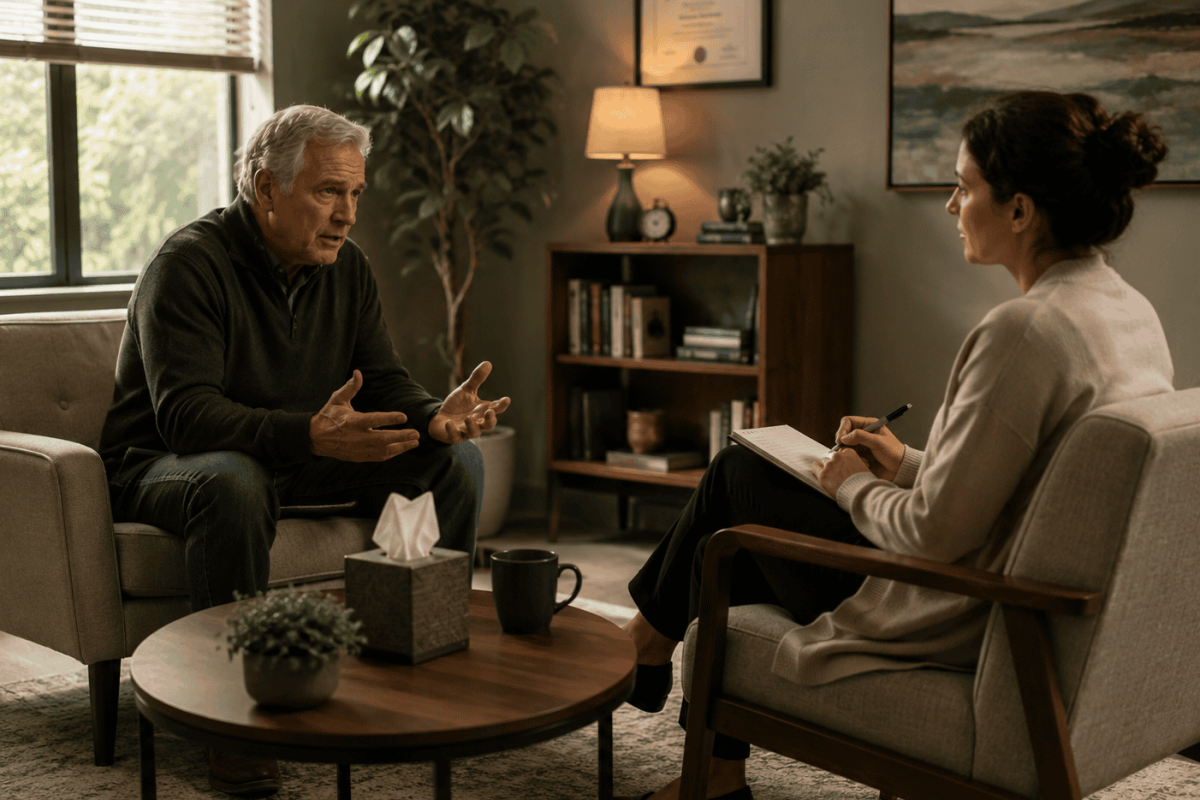

There’s a quiet assumption that runs through a lot of conversations about getting older: that by the time you reach 60, you’ve already figured yourself out. You’ve raised the kids, built the career, weathered the losses. Whatever’s left, the thinking goes, you simply manage on your own.
It’s a comforting story. It’s also wrong; and for a lot of people, it’s quietly harmful. The truth is that the second half of life brings its own distinct set of emotional challenges, and there is strong evidence that therapy works just as well for people in their 60s, 70s, and 80s as it does for anyone else. If you’ve been wondering whether it’s “too late” to start, the short answer is no. It never was.
Why later life is its own kind of hard
The years after 60 are often framed as a reward for decades of work, and for many people they are genuinely good years. But they also concentrate a remarkable number of major life transitions into a relatively short span of time.
Retirement, for all its appeal, can dismantle a sense of identity and daily structure that took forty years to build. As the National Institute of Mental Health notes, the life changes that come with aging, coping with serious illness, losing loved ones, growing isolation, can take a real toll on mental health. Friends and partners begin to fall ill or pass away, and grief in later life can stack up faster than there’s time to process it. Bodies change in ways that limit independence and shake confidence. Adult children move further away, and the social world that once felt full can start to feel thin. Add in the possibility of caregiving for an ailing spouse, and it’s no surprise that this stage of life can carry real emotional weight.
None of this is weakness. It’s the natural consequence of living long enough to accumulate both love and loss, and it’s exactly the kind of thing therapy is built to help with.
Depression isn’t a normal part of aging
One of the most persistent and damaging myths about getting older is that feeling down is simply part of the package. It isn’t. The National Institute on Aging is explicit on this point: depression is a common problem among older adults, but it is not a normal part of aging. While sadness in response to loss is normal, clinical depression is a treatable medical condition, not an inevitable feature of old age.
This myth does real harm because it leads people, and sometimes their doctors and families, to overlook symptoms that deserve attention. Late-life depression is common, yet it is frequently underdiagnosed and undertreated, partly because its signs can be mistaken for dementia, dismissed as a reasonable reaction to illness, or written off as “just getting old.” Older adults also tend to show depression differently than younger people: sometimes it surfaces less as visible sadness and more as fatigue, irritability, trouble sleeping, or a loss of interest in things that used to bring joy.
The stakes are not small. Untreated depression in older adults is linked to worse physical health, reduced independence, and higher mortality. The encouraging news, backed by decades of research, is that it responds well to treatment, and talk therapy is one of the most effective tools available.
What the evidence actually says
Here’s where the news gets genuinely hopeful. Evidence-based psychotherapies have been studied extensively in older adults, and they hold up. According to clinical guidance from the American Psychological Association, approaches like cognitive behavioral therapy (CBT), interpersonal therapy, and problem-solving therapy have all been shown to meaningfully reduce symptoms of depression and anxiety in people over 60.
These aren’t watered-down versions designed to humor older clients. They’re the same rigorous, structured approaches used at any age, and many older adults actually prefer them to medication, a meaningful point, given that older bodies often metabolize drugs differently and face more risk of side effects and interactions. For many people, therapy is not just an alternative to medication but a genuinely better first option.
There’s also a growing body of research showing that the benefits extend beyond depression into anxiety, grief, chronic-pain coping, and the broad work of adjusting to a changing life. Pairing therapy with physical activity tends to amplify the effect, which is one more reason a good therapist will often talk with you about movement, routine, and connection alongside whatever brought you in.
“But I’ve never done this before”
For many people over 60, therapy simply wasn’t part of the world they grew up in. Talking to a stranger about your private feelings may sound foreign, indulgent, or even shameful, a generational hangover from an era when mental health was rarely discussed openly.
If that’s you, it’s worth knowing two things. First, you don’t have to have a diagnosable illness to benefit. Plenty of people see a therapist to work through a single hard transition, to grieve, or simply to think out loud with someone trained to help. Second, the discomfort of starting tends to fade quickly. Most people are surprised by how ordinary and unintimidating those first conversations feel.
You also have more options than ever for how to do it. Online and telehealth therapy has expanded dramatically, and research shows it works well for older adults, which matters enormously if mobility, transportation, or distance from a provider has been a barrier. You can now meet a qualified therapist from your own living room.
How to take the first step
If any of this resonates, the path forward is more straightforward than you might expect.
Start by talking with your primary care doctor, who can rule out physical causes for how you’re feeling and offer a referral. From there, it helps to think about what you’re looking for: a therapist who has experience with older adults and with whatever you’re carrying, grief, a major transition, anxiety, depression, will generally be a better fit than someone chosen at random. Don’t be afraid to ask a prospective therapist directly about their experience working with people your age, and remember that it’s completely normal to try someone else if the first match doesn’t feel right.
When you’re ready to start your search, TherapyList makes it simple to find and connect with therapists who specialize in the issues that matter to you, including those who work specifically with older adults and who offer online sessions. You can filter by specialty, approach, and availability, and reach out on your own terms.
A different story about aging
The years after 60 can hold real richness, deeper relationships, hard-won perspective, time to invest in what actually matters. They can also hold real pain, and there is nothing about reaching this stage of life that means you have to carry that pain alone or simply endure it.
Therapy isn’t a last resort or a sign that something has gone wrong. It’s a tool for living well, available at every age. If you’ve been telling yourself it’s too late, consider this your permission to stop. It isn’t. It never was.
If you or someone you love is in crisis, you don’t have to wait. In the U.S., you can call or text the 988 Suicide and Crisis Lifeline at any time. For more on mental health and aging, the National Institute on Aging and the American Psychological Association offer trustworthy, accessible resources.


