
Are White-Collar Jobs at Risk? Reflections After Reading The Worst Case Future for White-Collar Workers
I recently read an article in The Atlantic titled The Worst Case Future for White-Collar Workers, and it gave me pause. Not because it was sensational, but because it articulated a quiet shift many people are already sensing.
For years, the implicit social contract has been simple: study hard, get a degree, secure a professional role, and you will have stability.
That assumption is beginning to wobble.
The Key Points That Stood Out
The article argues that while most graduates who want jobs still have them, the labour market for office workers is subtly changing. A few trends were particularly striking:
- A growing proportion of the unemployed now hold degrees
- Graduates are, in some cases, taking longer to secure roles than non-graduates
- Jobs most exposed to automation are showing sharper rises in joblessness
- Some firms are openly linking cost-cutting and layoffs to AI deployment
It also raises the possibility that AI-driven job losses may not behave like a typical recession. Instead of a temporary dip followed by recovery, we could see something more structural, where certain roles simply shrink or evolve permanently.
That distinction matters.
Cyclical Change vs Structural Change
Historically, economic downturns have been cyclical. Demand drops, governments intervene, hiring returns. But the concern raised in the article is different. If businesses no longer need the same volume of accountants, analysts, middle managers, or administrative staff, stimulus alone will not recreate those jobs.
We have seen something similar before, though in a different sector. From the 1970s onwards, automation and globalisation reshaped blue-collar employment. Communities built around manufacturing never fully recovered.
The unsettling suggestion is that white-collar workers may now be facing their own version of that transition.
Why This Feels Different to Previous Technological Shifts
Technology has always changed work. But most innovations historically created new jobs alongside productivity gains.
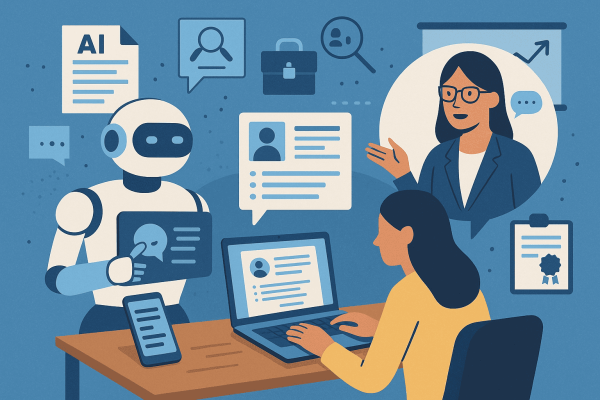
What feels different now is the speed and scope. AI tools can already draft reports, analyse data, write code, and automate routine professional tasks. Even if adoption is uneven, the direction of travel is clear.
And importantly, entry-level roles may be the most vulnerable. If fewer junior positions exist, the long-term pipeline of skilled professionals becomes disrupted.
The Psychological Dimension We Rarely Discuss
Much of the public conversation focuses on economics. Less attention is given to identity.
For many professionals, work is not just income. It is structure, purpose, and social connection. Long-term unemployment does not simply affect finances. It affects mental health, confidence, and sense of relevance.
This is not speculation. We already know from past labour market shocks that prolonged job loss correlates with poorer wellbeing and reduced life satisfaction.
My Professional Perspective
As someone who has worked in careers and later-life psychology for decades, I would urge caution against panic narratives. Predictions of “job carnage” make compelling headlines, but the reality is usually more nuanced.
Three observations feel more grounded:
First, some companies may be overstating AI’s impact. “AI-washing” can mask ordinary cost-cutting or restructuring decisions.
Second, work rarely disappears entirely. It reshapes. New roles emerge, often in areas we do not yet fully recognise.
Third, adaptability, not prediction, has always been the more reliable strategy.
My Suggestion: A More Constructive Response
Rather than asking “Will AI eliminate white-collar work?” a more useful question might be:
“How do I remain relevant in a changing professional landscape?”
Practical steps include:
- Strengthening human-centred skills such as judgement, communication, and relationship-building
- Updating digital literacy rather than resisting technological tools
- Expanding identity beyond a single job title
- Considering portfolio careers or blended roles over time
This is especially important for midlife and older professionals, who may wrongly assume they are “too late” to adapt. In reality, experience, context, and wisdom are precisely the qualities least easily automated.
A Final Reflection
The article ends with uncertainty, and I think that is appropriate. No one truly knows the scale or speed of AI’s impact on white-collar work.
What we do know is this:
Every major technological shift has generated anxiety about the future of work.
Some fears prove exaggerated. Others prove partially true.
But the individuals who fare best are rarely those who panic or deny change. They are the ones who stay reflective, informed, and psychologically flexible.
From a careers perspective, that has always been the real advantage, and it remains so now.